Antique furniture is frequently described by period style: "Chippendale", "Sheraton", "Regency". These words describe a look, often taken from published pattern books, and were applied to furniture made long after the original designers worked. Thomas Chippendale's Director of 1754, the Hepplewhite Guide of 1788 and Thomas Sheraton's Drawing-Book of the 1790s were used by many workshops. Construction evidence is how you separate a period piece from a later revival.
Read the joints
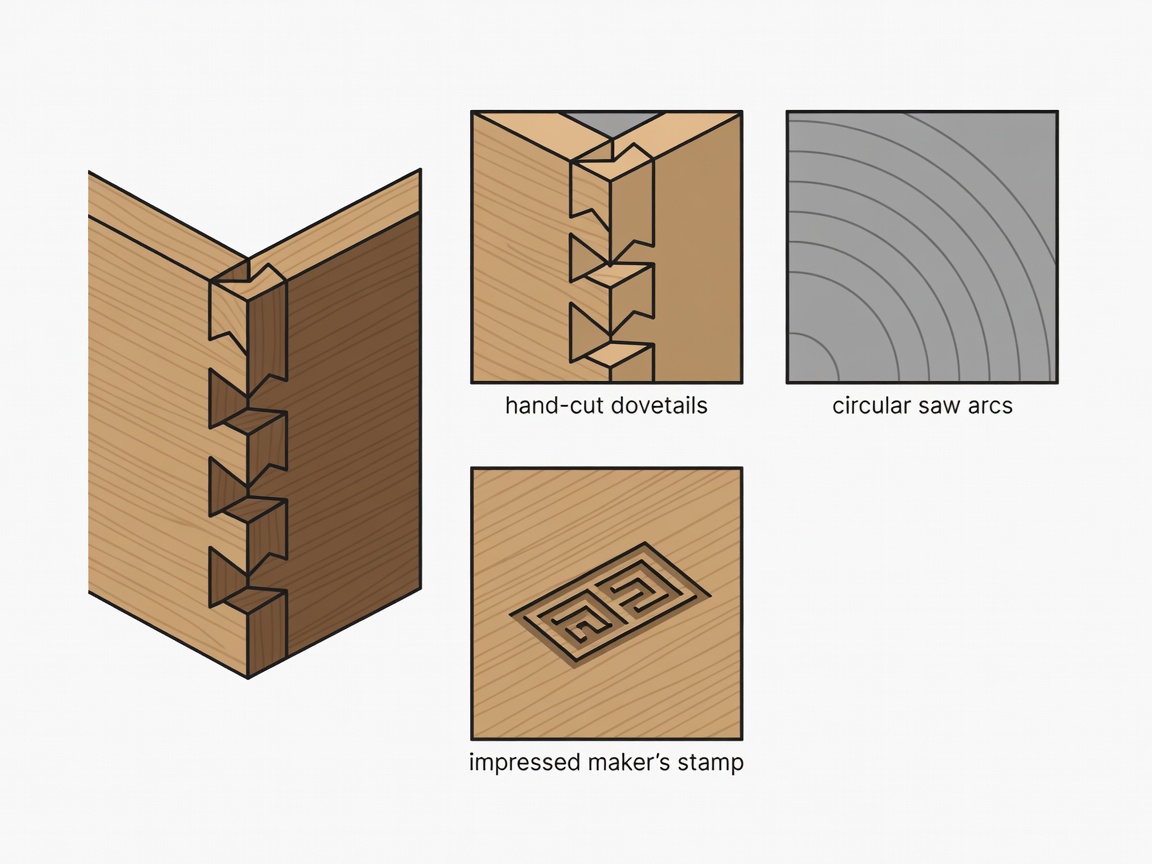
Pull out a drawer and look at its front corners. Hand-cut dovetails tend to have narrow pins, slightly irregular spacing, and a faint scribe line where the maker marked the depth. Machine-cut dovetails are evenly sized and evenly spaced. The pin-and-scallop Knapp joint, patented by Charles Knapp in 1867, is a distinctive later machine joint and a useful date marker on American furniture.
Mixed evidence matters. One drawer with different joints from its neighbours may be a replacement. Record which drawer, and how it differs.
Saw marks and tool marks
Turn the piece over and examine unfinished surfaces: drawer bottoms, backboards and the underside of tops. Straight, roughly parallel marks are associated with pit saws and frame saws. Regular curved arcs come from circular saws, which came into widespread use during the nineteenth century. Hand-plane marks show as shallow, slightly scalloped ridges. These observations narrow a date range; they rarely give a single year.
Screws, nails and hardware
Early handmade screws often have irregular threads, blunt ends and off-centre slots. Machine-made, gimlet-pointed screws became common from the mid-nineteenth century. Cut nails with rectangular shanks preceded the wire nails that dominated by the late nineteenth century. Handles and escutcheons are easily replaced, so look for filled holes or ghost outlines in the timber that show earlier hardware.
Finishes
Shellac, applied as French polish, was widespread in the nineteenth century; later lacquers and synthetic finishes followed. Conservators use ultraviolet light to distinguish finishes, because many fluoresce differently. A thick, even, plastic-looking finish on an early piece usually means it was refinished. That history is worth recording, not hiding.
Maker's stamps and labels
Some workshops marked their work. Gillows of Lancaster stamped many pieces with its name, and twentieth-century makers such as Herman Miller, maker of the Eames Lounge Chair introduced in 1956, used labels and medallions. Stamps can be added later and labels can be transferred, so check that wear, dirt and wood colour around a mark match the surrounding surface.
Found and historical objects
Ceramics, metalwork and small objects carry their own date clues. British design registration diamond marks were used from 1842 to 1883, and numbered "Rd" marks followed from 1884. After the US McKinley Tariff of 1891, many exporters added a country of origin such as "England"; the fuller "Made in England" became common later. Factory marks, retailer stamps and museum or inventory numbers painted on bases are all worth photographing.
A mark establishes what the mark says. It does not by itself confirm who owned an object or where it has been. Family stories are valuable leads; record them as attributed, and look for documents that name the object.
Restoration notes
Re-gluing loose joints
Replacing hardware
Repairing chipped ceramics
Verified in the archive
- Joint type and saw marks observed
- Stamps and labels photographed in context
- Registration or Rd numbers transcribed
Open questions
- Workshop attribution from style alone
- Ownership by named historical figures
- Whether labels were transferred