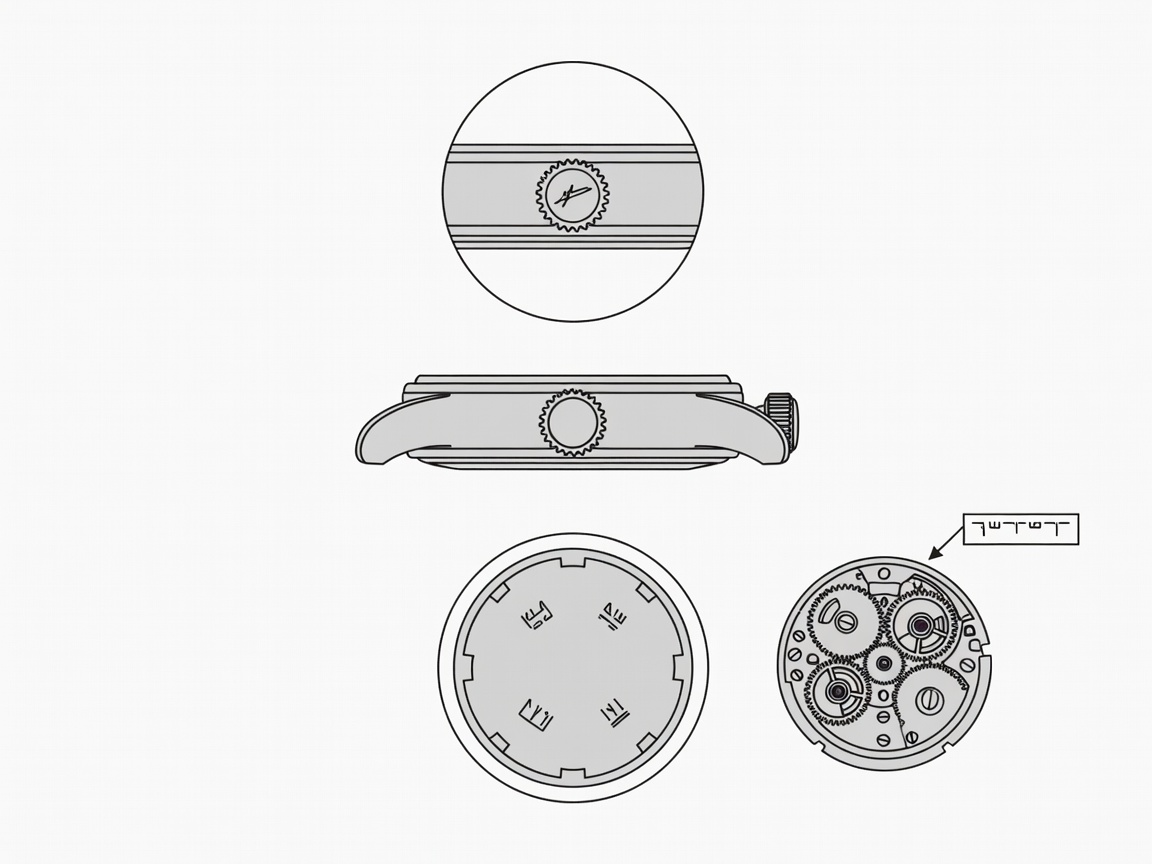
A watch is a small machine inside a protective shell, and both parts are routinely serviced, replaced and swapped over a working life. The aim of inspection is to understand which parts belong together, what work has been done, and where the record runs out.
Begin at the crown
The crown is handled more than any other part, so it is often replaced. Check whether it is signed, whether its size and style suit the case, and whether it screws down where the model should have a screw-down crown. The Oyster case Rolex patented in 1926 made the sealed screw-down crown famous; on such cases a plain or oversized crown is a prompt to ask about service history. A replacement crown is common and acceptable, but it should be recorded.
Turn the watch over
Case backs carry maker's names, case serials, reference numbers and, on precious-metal cases, hallmarks. British hallmarks include a sponsor's mark, a standard mark, an assay office mark and often a date letter. Assay office symbols are well documented: the leopard's head for London, the anchor for Birmingham, the crown for Sheffield until 1975, and three wheatsheaves with a sword for Chester, which closed in 1962. Many Swiss movements were cased in Britain or imported into British-hallmarked cases, so a British mark does not settle the origin of the movement.
Photograph hallmarks with raking light and compare them against a reputable reference such as Bradbury's Book of Hallmarks. Wear, polishing and later re-casing can make marks difficult to read; record uncertain letters as uncertain.
Repairer's marks
For much of the twentieth century, watchmakers scratched small dates, initials or job numbers inside case backs. A sequence of these marks is a service history written directly on the object. Photograph them before any new service, and ask your watchmaker not to polish them away. They rarely identify a named person, so treat them as dated observations rather than provenance.
Movement and calibre
Calibre numbers are often stamped under the balance or on the dial side of the movement, with a movement serial nearby. Published brand references allow you to check whether a calibre was in use during the period suggested by the case. A mismatch between calibre era and case era is one of the clearest signs that a watch has been assembled from different sources. Only open a case back if you have the correct tools and experience; otherwise ask a watchmaker to photograph the movement for you.
American railroad-grade pocket watches from makers such as Hamilton and Elgin carry another layer of evidence. Railroad timekeeping standards tightened after the 1891 Kipton, Ohio collision, and Webb C. Ball's inspection system shaped requirements for many lines.
Dials and luminous material
A redial is a dial that has been refinished. Warning signs include unusually crisp printing on an otherwise worn watch, uneven fonts, spelling errors and lume that looks fresh beside aged hands. Radium-based luminous paint was widely used until around the 1960s; it remains radioactive and should not be scraped, sanded or handled carelessly. Tritium followed, and many Swiss dials marked "T SWISS T" or "SWISS T < 25" indicate tritium content.
What we cannot decide remotely
Originality of a dial, the authenticity of a rare reference and the value of a watch all require hands-on examination by qualified specialists, often with access to brand archives. We describe how to gather evidence for that conversation.
Restoration notes
Full service
Case polishing
Relume or redial
Verified on this bench
- Hallmarks read and photographed
- Calibre and serials recorded
- Repairer's marks transcribed
Open questions
- Whether dial and hands are original
- Original owner without papers
- Factory versus later case pairing